
Failure vs. Follow-Through: Comparing Apollo 13 and Artemis II

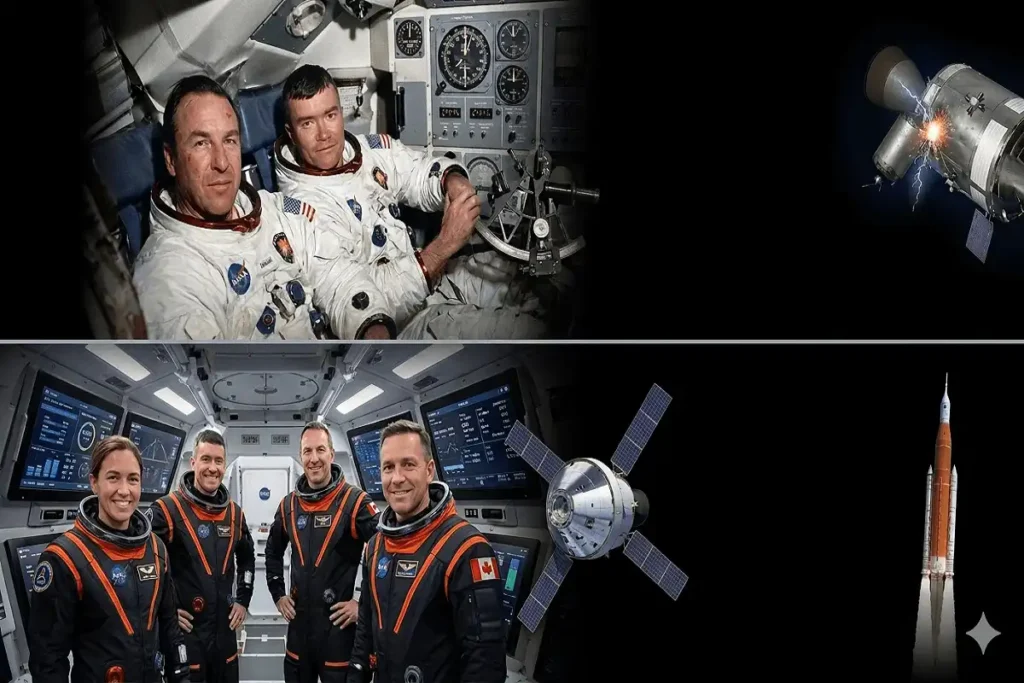
Apollo 13 vs Artemis II : More than five decades separate Apollo 13 and Artemis II, but both missions share the same destination: the Moon. One became a legendary survival story. The other aims to write a new chapter in human spaceflight.
In 1970, an oxygen tank explosion turned a lunar landing into a life-or-death rescue. In 2026 (or soon after), four astronauts will fly farther from Earth than anyone has in over 50 years – this time, by design.
So how do these two missions truly compare? Let’s examine the technology, the danger, and the legacy of Apollo 13 vs Artemis II.
Mission Snapshots: Apollo 13 vs Artemis II
| Feature | Apollo 13 (1970) | Artemis II (2026) |
|---|---|---|
| Primary goal | Land on the Moon | 10-day lunar flyby |
| Crew | 3 astronauts | 4 astronauts |
| Spacecraft | Command Module + Lunar Module | Orion + European Service Module |
| Outcome | Emergency return; no landing | Planned flyby (pending success) |
| Farthest distance from Earth | ~400,171 km | ~434,500 km (record breaker) |
Key takeaway: Artemis II will fly farther than any human has ever traveled – including Apollo 13.
1. Technology: Slide Rules vs. Software
Apollo 13’s “Flying Tin Can”
The Apollo Guidance Computer had less processing power than a modern toaster. Astronauts flipped physical switches, used paper checklists, and relied on slide-rule calculations from Mission Control. When the explosion happened, engineers invented a CO₂ scrubber fix using plastic bags, duct tape, and cardboard – all while the crew froze in a powerless module.
Artemis II’s Digital Cockpit
Orion features:
Modern avionics and automated navigation
A carbon-fiber heat shield (Apollo-era design, 21st-century materials)
Redundant life support systems
Touchscreen interfaces (with physical backups)
Verdict: Apollo 13 was a marvel of analog ingenuity. Artemis II is a testament to digital redundancy. But both depend on human problem-solving when things go wrong.
2. Risk and Survival: Reactive vs. Proactive
Apollo 13: The Unplanned Nightmare
Cause of crisis: Exploded oxygen tank (wiring fault + damaged insulation)
Lifeboat: Lunar Module Aquarius (designed for 2 people, 2 days – kept 3 alive for 4 days)
Key survival tools: Lithium hydroxide canisters, manual engine burns, cold-water rationing
Artemis II: Safer by Design… With Fewer Options
No lunar module backup. If Orion fails, there’s no second ship.
Tested systems: Artemis I (uncrewed) validated the heat shield and trajectory.
Launch abort system can pull the crew to safety during ascent – but not in deep space.
Contrast: Apollo 13 survived in spite of design limits. Artemis II is designed to prevent failures, but has a narrower margin for error once beyond Earth’s orbit.
3. Mission Success: Survival vs. Execution
| Metric | Apollo 13 | Artemis II |
|---|---|---|
| Primary goal achieved? | ❌ No landing | ⏳ TBD |
| Crew returned safely? | ✅ Yes | ⏳ TBD |
| Engineering lessons learned | ✅ Immense | ⏳ Planned |
| Public legacy | “Successful failure” | First woman, first person of color, first Canadian around the Moon |
Apollo 13’s success was redefined mid-mission.
Artemis II’s success is predefined: validate Orion’s life support, navigation, and heat shield before Artemis III lands on the Moon.
What’s Surprisingly Similar
Despite the decades between them, Apollo 13 and Artemis II share DNA:
Mixed crews: Veterans + rookies on both missions.
Global attention: Apollo 13 captivated the world by accident. Artemis II does so by intention – breaking barriers in spaceflight diversity.
Stepping-stone roles: Apollo 13 was meant to be the third lunar landing. Artemis II is the first crewed test before returning humans to the lunar surface.
Both missions prove a simple truth: the Moon doesn’t care about your plans. Only your preparation.
FAQ: Apollo 13 vs Artemis II
Which mission went farther from Earth?
Artemis II will break Apollo 13’s record, reaching approximately 434,500 km from Earth – the farthest any human will have traveled.
Did Apollo 13 fail or succeed?
It’s called a “successful failure.” Failed the lunar landing. Succeeded in bringing the crew home against impossible odds.
Will Artemis II land on the Moon?
No. Artemis II is a flyby mission. The landing happens with Artemis III (planned for later).
Is Artemis II safer than Apollo 13?
In design, yes. But it has no lifeboat (lunar module). Risk profiles are different – not necessarily lower.
Final Verdict: What Each Mission Teaches Us
| Lesson | Apollo 13 | Artemis II |
|---|---|---|
| Resilience | ✅ Improvise under fire | ⏳ Yet to be tested |
| Engineering | ✅ Brilliant analog workarounds | ✅ Modern redundancy |
| Diversity | ❌ All white men | ✅ First woman, person of color, Canadian |
| Future impact | Created NASA’s culture of “never give up” | Will define the Artemis generation |
Apollo 13 turned disaster into a masterclass in problem-solving.
Artemis II aims to turn preparation into poetry.
💬 Which mission fascinates you more – the survivor (Apollo 13) or the pioneer (Artemis II)?
Drop a comment below or share this post with a space-loving friend.